
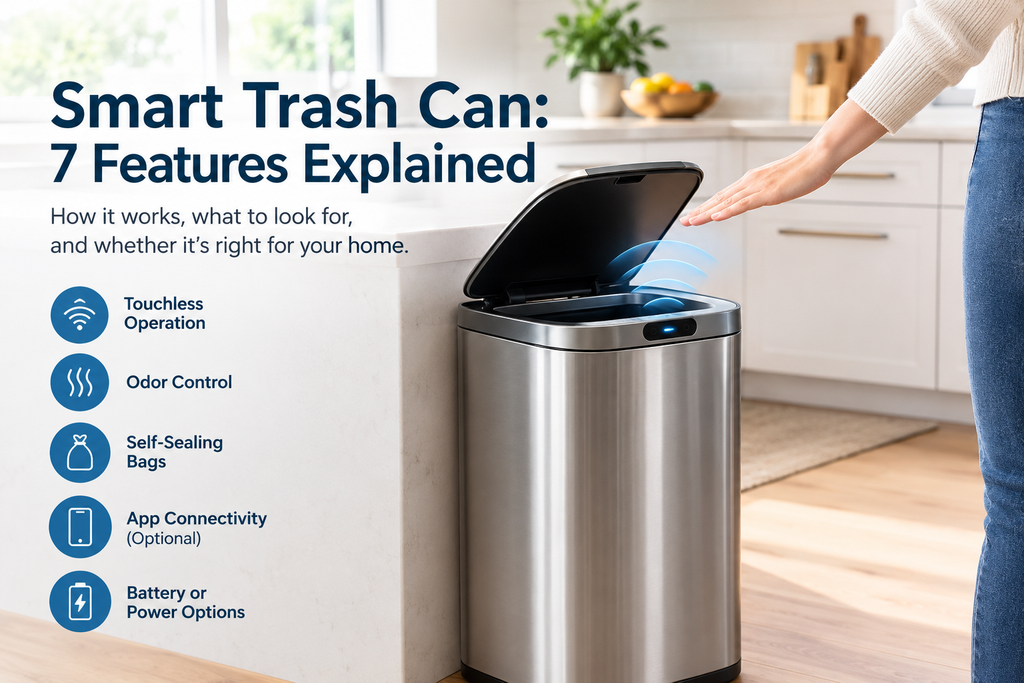
You’ve seen a trash can open automatically when someone approaches it, or perhaps you’ve spotted one that seals its own bags and wondered what makes it different from an ordinary bin. The good news is that the technology is easier to understand than it looks, and knowing how the features work can help you decide which ones are worth considering for your home.
Quick Answer: A smart trash can is a waste container that uses technology to simplify waste disposal, often with a motion sensor that opens the lid automatically. Depending on the model, additional features may include odor control, self-sealing bags, automatic bag replacement, or app connectivity. Most basic sensor-operated models do not require an internet connection.
Table of Contents
What You Need to Know
- Automatic opening: A sensor detects movement and activates the lid mechanism without requiring you to touch the lid.
- Optional features: Odor-control systems, self-sealing bags, and app connectivity are available on some models, not all.
- Power and maintenance: Electronic lids need a power source, and the bin still requires regular cleaning and bag replacement.
- Best use: Kitchens, bathrooms, and home offices can benefit from touchless operation when the bin’s size and features suit the space.
- Before choosing: Check capacity, lid clearance, power requirements, compatible bags, and ongoing costs rather than relying on the word “smart” alone.
What Is a Smart Trash Can? Meaning and Definition
A smart trash can is a waste container that uses electronic or automated features to make everyday waste disposal more convenient. The most common household version has a sensor-operated lid, while advanced models may include additional bag-handling or connectivity features.
Smart trash can meaning in simple words
Think of a regular bin with an added mechanism that performs a task for you. Instead of lifting the lid by hand, you move your hand or an object near the sensor, and the lid opens automatically.
The word “smart” describes the added functionality. A sensor-operated lid does not automatically mean that a bin connects to Wi-Fi, uses artificial intelligence, or communicates with your phone.
What makes a trash can smart?
The main distinction is how the bin operates and which additional functions it provides.
- A conventional trash can usually has a manual lid or no lid.
- An automatic trash can uses an electronic mechanism to open and close its lid.
- A more advanced model may add self-sealing bags, automatic bag replacement, or app-connected functions.
The phrase automatic trash can usually refers to the opening mechanism, while smart bin can describe a broader range of automated features. Manufacturers do not always use these terms consistently, so check the actual specifications.
How Does a Smart Trash Can Work?
A sensor-operated bin detects movement, activates its lid mechanism, and closes the lid after the programmed interval or when its control system determines that closing is appropriate. The basic operating sequence is detection, activation, opening, and closing.
How motion sensors detect movement
A motion sensor is an electronic component that detects movement or a change in its surroundings, depending on the sensing technology used. In a household bin, the sensor is commonly positioned near the lid.
When your hand approaches the detection area, the sensor sends a signal to the control circuit. The circuit activates the lid mechanism if the system is operating correctly.
How the lid opens and closes

Step 1: Approach the sensor.
Move your hand or the waste item toward the designated sensing area. The exact detection distance depends on the model and its settings.

Step 2: Let the mechanism open the lid.
The sensor signals the control circuit, which activates the motor or other opening mechanism. Place your waste inside once the lid has opened sufficiently.

Step 3: Allow the lid to close.
The bin follows its programmed closing behavior. Opening duration, sensor response, and closing delays vary by product, so consult the manufacturer’s manual for the exact timing.
Batteries, power, and electronic components
The sensor and lid mechanism require energy. Depending on the model, the bin may use replaceable batteries, rechargeable power, or an external power source.
Before buying, check battery accessibility, charging requirements, and whether the lid can still be operated manually when power runs out. Do not assume that every model has the same backup or manual-opening options.
Smart Trash Can Features Explained
A smart trash can may include several useful features, but the feature list differs significantly between models. Choose features according to your actual needs rather than assuming that a higher number of features means better performance.
Touchless automatic lid
A touchless lid opens without requiring you to touch the lid itself. This can be convenient when your hands are occupied during food preparation or when you want to avoid touching a frequently handled surface.
However, touchless opening does not make the entire bin germ-free. The exterior, rim, liner, and surrounding floor still need routine cleaning.
Odor-control features
Odor-control features are designed to help contain or reduce unpleasant smells. Depending on the design, a bin may rely on a better-fitting lid, a replaceable filter, or another odor-management mechanism.
A lid that closes securely can help contain odors, but performance also depends on the waste inside, how long the waste remains in the bin, and how often the container is cleaned.
Self-sealing and self-changing bags
These two features sound similar but do different jobs.
- Self-sealing system: A mechanism seals the filled bag or its opening on supported models, potentially reducing direct handling.
- Self-changing bag system: A mechanism helps replace a used bag with a new one, sometimes using a specialized refill cartridge.
- Standard liner system: You remove the full bag and fit a replacement yourself.
Not every automatic bin supports these functions. Check refill availability, compatible bag dimensions, and recurring costs before choosing a specialized system.
App connectivity and smart controls
An app-connected bin may provide digital controls or status information, depending on its design. App connectivity is an optional feature, not a basic requirement for automatic lid operation.
Before relying on an app, verify whether the product requires a smartphone, Wi-Fi, Bluetooth, or an account. The manufacturer’s documentation should explain which functions remain available without a connection.
Benefits and Limitations of a Smart Trash Can
Automatic bins can make waste disposal more convenient, particularly when your hands are occupied. They also introduce extra components that need power and maintenance, so the advantages depend on the model and your household routine.
Potential benefits for everyday use
- Convenience: Open the lid without manually lifting it.
- Reduced contact with the lid: Helpful when handling food waste or other household rubbish.
- Controlled lid operation: The lid can close after use instead of remaining open, depending on the model.
- Optional bag-handling features: Certain systems reduce the need to handle bags directly.
- Flexible placement: Different sizes and designs can suit kitchens, bathrooms, and home offices.
One counterintuitive point is worth remembering: a simpler automatic bin may be more practical than a feature-packed model if you do not need specialized bags, app connectivity, or other extras. More technology can mean more components to maintain.
Disadvantages to consider
| Consideration | What it means for you |
|---|---|
| Power dependence | Electronic functions need an appropriate power source. |
| Maintenance | Sensors, moving parts, and lid mechanisms need care. |
| Purchase and operating costs | Specialized features or refills may add ongoing expenses. |
| Bag compatibility | Some systems require specific liners or cartridges. |
| False or missed activation | Sensor performance can vary with placement, settings, and surroundings. |
| Space requirements | The lid needs enough clearance to open properly. |
The best choice balances useful convenience against cost, maintenance, and the physical space available in your home.
Smart Trash Can vs. Regular Trash Can
The primary difference is that a sensor-operated bin automates lid operation, while a conventional bin generally relies on manual operation. A conventional bin may still be the better choice when low cost, simplicity, and minimal maintenance matter most.
| Feature | Automatic bin | Conventional bin |
|---|---|---|
| Lid operation | Sensor-operated on supported models | Usually manual or lidless |
| Power | Required for electronic features | Usually not required |
| Touchless opening | Available | Not normally available |
| Specialized bag systems | Available on certain models | Usually replaced manually |
| App connectivity | Optional on some models | Not normally available |
| Maintenance | Includes electronic and mechanical components | Generally simpler |
| Ongoing costs | May include batteries or specialized refills | Usually standard liners |
| Best fit | Users who value automated operation | Users who prioritize simplicity |
The table describes common design differences, not a universal specification for every product. Manual override options, bag systems, and other features vary by model.
Smart Trash Can Feature Decoder
Use this reference chart to identify what each feature actually does and what to check before choosing a bin.
| Feature | Purpose | What to verify |
|---|---|---|
| Motion sensor | Detects movement to activate the lid | Response, placement, and settings |
| Manual control | Allows button-operated lid control | Whether the model provides it |
| Odor-control design | Helps contain or reduce odors | Cleaning and filter requirements |
| Self-sealing system | Seals a bag on supported models | Compatible bags and refill costs |
| Self-changing bags | Helps automate bag replacement | Cartridge availability and operating costs |
| App connectivity | Adds digital functions on supported models | Connection and account requirements |
| Battery or mains power | Supplies energy to electronic components | Battery type or outlet needs |
Save or screenshot this Smart Trash Can Feature Decoder — it covers what each feature does and what to verify before choosing a model.
Where Can You Use a Smart Trash Can?
A sensor-operated bin can work in several indoor spaces, provided its size, capacity, lid movement, and power requirements suit the location. The right placement matters as much as the technology.
Smart trash cans for kitchens
Kitchen use can be convenient when your hands are occupied with food preparation or cleaning. Check the bin’s capacity, lid clearance beneath cabinets, and the ease of removing a full liner.
Also consider where food waste will accumulate. A touchless lid does not replace regular emptying, cleaning, or sensible food-waste handling.
Smart trash cans for bathrooms
A compact bin may suit a bathroom where space is limited and a closed lid is preferred. Measure the available floor space and confirm that the lid can open without hitting a wall, vanity, or nearby fixture.
For smaller rooms, the footprint and lid design may matter more than advanced connectivity features.
Home offices and other indoor spaces
An automatic bin can be useful in a home office, bedroom, or hobby room when convenient disposal is a priority. Match the bin’s capacity to the waste you produce rather than choosing a larger model solely for its features.
For rooms with limited space, check the lid’s full movement and whether the power arrangement is practical for the intended location.
What Should You Check Before Choosing a Smart Trash Can?
Before choosing a model, identify the features you will actually use, the space available, and the ongoing maintenance requirements. A short checklist can prevent you from paying for functions that do not solve a real problem.
Size, capacity, and lid clearance
Measure the space where the bin will sit, including the vertical clearance required for the lid to open. Check the stated capacity and the dimensions of the entire unit, not just the container body.
For kitchen use, also consider how frequently you want to empty the bin. A larger capacity may reduce emptying frequency, but it can take up more floor space.
Power, bags, and ongoing maintenance
Verify the power source, compatible liners, and cleaning requirements. If the bin uses specialized refill cartridges, check their availability and replacement cost before committing to the system.
The manufacturer’s instructions should explain how to clean the bin safely, maintain the sensor, and handle batteries or charging components.
Features worth prioritizing for your home
Use this simple decision checklist:
- Measure the available floor space and lid clearance.
- Choose a suitable capacity for your household’s waste.
- Confirm the power source and battery requirements.
- Check whether standard bags fit.
- Verify whether odor-control filters or specialized refills are required.
- Decide whether app connectivity or automated bag handling is genuinely useful.
- Read the cleaning and maintenance instructions.
If you want to learn more about household waste management, the U.S. Environmental Protection Agency’s waste and recycling resources provide additional context on reducing waste and recycling responsibly.
Once you understand these requirements, your next step can be a dedicated comparison of models that match your budget, space, and preferred features. No specific product is recommended here because verified product comparisons and prices have not been supplied.
Planning a smarter home? A future SmartTrashHub email checklist could help you compare bin capacity, bag compatibility, power requirements, and maintenance before making a purchase.
Common Mistakes When Choosing or Using an Automatic Trash Can
Many problems arise from mismatched expectations, unsuitable placement, or neglected maintenance. Checking the product manual and installation requirements before use can prevent avoidable frustration.
Mistake 1: Assuming every bin is app-connected
The word “smart” does not guarantee Wi-Fi, Bluetooth, or smartphone control. Read the feature list and confirm whether the bin operates independently.
Mistake 2: Buying specialized bags without checking compatibility
Some self-sealing or self-changing systems require particular liners or cartridges. Confirm the exact refill type and its ongoing cost before purchasing the bin.
Mistake 3: Placing the sensor where it activates unexpectedly
Nearby movement or unsuitable placement may interfere with convenient operation on some models. Follow the manufacturer’s positioning recommendations and adjust available sensitivity settings if the product supports them.
Mistake 4: Expecting a touchless lid to eliminate germs and odors
Touchless operation reduces the need to touch the lid, but the container still collects waste and can develop odors. Empty the bin regularly and clean the surfaces according to the manufacturer’s instructions.
Mistake 5: Ignoring power and maintenance requirements
A low battery, dirty sensor, or obstruction can interfere with operation. If the lid stops working, check the power supply, look for visible obstructions, and consult the manual before attempting any repair.
Smart Trash Can FAQs
What is a smart trash can?
A smart trash can is a waste container that uses automated or electronic features to simplify disposal. Most commonly, a sensor detects movement and activates the lid without requiring manual contact. Some models add odor-control features, self-sealing bags, automatic bag replacement, or app connectivity. The exact functions depend on the model, so check its specifications rather than assuming every smart bin includes the same technology.
What is an automatic trash can?
An automatic trash can uses an electronic mechanism to open or close its lid, commonly in response to a motion sensor. The sensor detects movement in its sensing area and signals the lid mechanism to operate. Most household models use a battery or another power source. Automatic operation describes the lid mechanism and does not necessarily mean the bin connects to the internet or uses an app.
Does a smart trash can need an app?
No. Many sensor-operated trash cans open and close without a smartphone app or internet connection. App connectivity is an optional feature on certain models, and its functions vary by manufacturer. If you want remote controls or digital status information, check whether the specific model supports those functions and whether a connection or account is required. Do not assume an app is necessary simply because a product is marketed as smart.
Does a smart trash can need batteries?
Many automatic household bins use batteries to power their sensors and lid mechanisms, while some models use rechargeable batteries or an external power source. The required battery type, expected operating life, and replacement procedure vary by product and usage. Check the manufacturer’s specifications before buying, especially if the bin will be placed somewhere difficult to access. If the power fails, use only the manual-opening or troubleshooting procedures specified by the manufacturer.
Can a smart trash can control odors?
Some smart trash cans help contain odors through a well-fitting lid, a sealing mechanism, or an optional filter. However, automatic opening alone does not eliminate unpleasant smells, and no design guarantees completely odor-free operation under all conditions. Performance depends on the waste, how long it remains inside, the lid design, and cleaning frequency. Empty the bin regularly and follow the product’s instructions for cleaning and replacing any odor-control components.
Can you use regular trash bags in a smart trash can?
Some sensor-operated bins accept ordinary trash bags, while certain self-sealing or self-changing systems require compatible liners or refill cartridges. Check the manufacturer’s recommended bag dimensions, attachment method, and any model-specific restrictions before purchasing replacements. Using an incompatible bag can interfere with fitting or automated bag-handling functions. If low ongoing cost is important, confirm the availability and price of compatible bags before choosing a specialized system.
Are smart trash cans worth it?
A smart trash can may be worth considering if touchless opening makes everyday disposal more convenient for your household. The value depends on how often you use the bin, the features you need, the purchase price, and ongoing costs such as batteries or specialized refills. A conventional bin may be more practical if you prefer simplicity and minimal maintenance. Compare the actual functions and operating requirements rather than relying on marketing labels alone.
Are smart trash cans suitable for bathrooms?
Yes, a compact automatic bin can suit a bathroom if its dimensions, lid clearance, and power requirements fit the available space. Measure the intended location before choosing a model, especially if the bin will sit beneath a vanity or near a wall. Also consider the ease of cleaning and the frequency of emptying. A smaller model with straightforward operation may be more practical than a larger bin with features you will rarely use.
What does a self-sealing trash can do?
A self-sealing trash can uses a mechanism designed to seal a filled bag or its opening, depending on the product. This differs from a conventional automatic bin, which only opens and closes its lid. Some systems use specialized refill cartridges, so check bag compatibility, replacement availability, and operating costs before deciding whether the feature is useful for your household.
What should you look for in a kitchen garbage bin?
For a kitchen bin, prioritize suitable capacity, a lid that clears nearby cabinets, easy liner replacement, and straightforward cleaning. A sensor-operated lid can be convenient when your hands are occupied, but advanced features are not essential for every household. If you prepare food frequently, also consider how easily the bin can be emptied and how the lid design contains odors between cleanings.
What is the difference between self-sealing and self-changing bags?
Self-sealing systems are designed to seal a bag, while self-changing systems help remove or replace a used liner with a new one. These are separate functions, and a product may offer one without the other. Some systems require proprietary cartridges or compatible bags. Check the manufacturer’s documentation to understand which process is automated and what consumables the bin requires.
What to Do Next
You now have the foundation to understand how automatic bins work and which features matter most. The next step is to compare specific needs before moving toward a purchase.
- [CONTENT GAP: Automatic trash can buying guide] — Compare capacity, power, bag compatibility, and maintenance requirements.
- [CONTENT GAP: Smart trash can comparison] — Understand the practical differences between conventional bins and automated models.
- [CONTENT GAP: Smart trash cans for kitchens] — Explore size, placement, lid clearance, and everyday kitchen use.
These are proposed internal destinations, not published pages. Add internal links once the corresponding SmartTrashHub articles are live. A future buying guide is the most natural commercial bridge for readers who have moved from understanding the technology to comparing products.
Pingback: Are Smart Trash Cans Worth It? 7 Key Factors