
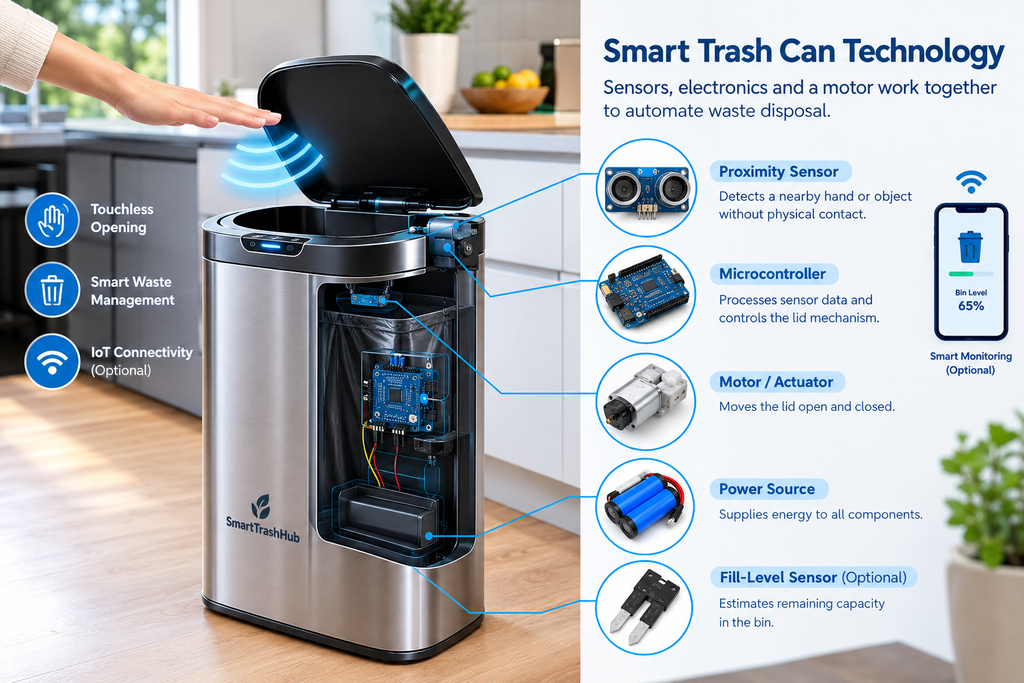
If you have watched a trash can open its lid as your hand approaches, you may wonder how the sensor, electronics, and motor coordinate without a button. The answer is simpler than it looks: understanding the main components helps you distinguish basic automatic bins from connected smart waste systems.
Quick Answer: Smart trash can technology uses sensors, electronic controllers, and mechanical components to automate waste disposal. A proximity sensor detects a nearby hand, a microcontroller processes the signal, and a motor opens the lid. More advanced systems may measure waste levels, send wireless notifications, or connect to monitoring software, depending on the model.
Table of Contents
What You Need to Know
- A proximity sensor detects a nearby hand or object without requiring physical contact.
- A microcontroller processes sensor readings and controls the lid mechanism.
- A motor or actuator moves the lid, while a power source supplies the required energy.
- IoT connectivity is optional; automatic opening does not necessarily require Wi-Fi.
- Fill-level monitoring uses additional sensing and software to estimate how much space remains.
How Does Smart Trash Can Technology Work?
Smart trash can technology combines sensing, electronic control, and mechanical movement to automate specific waste-disposal tasks. The core operating cycle has four stages: detect, process, actuate, and reset.

1. Detect a nearby object
A proximity sensor detects a hand or object entering its detection area. An ultrasonic sensor uses sound waves to estimate distance, while other designs may use infrared or different sensing methods.

2. Process the sensor signal
A microcontroller evaluates the sensor reading against programmed conditions. For example, a prototype might open the lid when an object is detected within a set distance.

3. Activate the lid mechanism
A motor or actuator moves the lid. The exact mechanism depends on the bin’s design, lid weight, and control system.

4. Close and return to standby
After the programmed delay or another closing condition, the controller returns the lid to its closed position. The sensor then continues monitoring for the next approach.
The Arduino Education Trash Can Project demonstrates this basic arrangement with an ultrasonic sensor, an Arduino board, and a servo motor. Its example includes a one-second wait before the closing movement. Actual timing varies by design. Arduino Education+1
What Components Are Inside a Smart Trash Can?
A smart trash can may contain a sensor, controller, motor, power source, and optional connectivity hardware. The components depend on which functions the manufacturer intends the bin to perform.
Smart Trash Can Technology: Component and Function Chart
| Component | What it does | Always required? |
|---|---|---|
| Proximity sensor | Detects a nearby hand or object | Required for sensor-based automatic opening, but not every smart-bin design |
| Microcontroller or control circuit | Processes signals and coordinates actions | A control system is needed; a separate microcontroller is not universal |
| Motor or actuator | Moves the lid | Required for motorized lid movement, but mechanisms vary |
| Battery or power supply | Provides electrical energy | A power source is required; its type varies |
| Fill-level sensor | Estimates remaining space | No |
| Wireless communication module | Transmits data to other devices or software | No |
| Indicator light or display | Communicates status or alerts | No |
Save or screenshot this Smart Trash Can Technology: Component and Function Chart — it covers the main components, their functions, and which features are optional.
The chart also highlights a useful distinction: a bin can open automatically without monitoring its fill level, and a connected waste container can monitor capacity without using the same lid-opening mechanism as a household model. Springer Nature Link+1
What does each component contribute?
Sensors provide information. They detect proximity, distance, or another physical condition. Their readings are the starting point for automated decisions.
The controller makes decisions. A microcontroller is a small programmable computing device that reads inputs and controls outputs. Its program determines when the motor should move and when the system should wait.
The actuator performs the physical action. A servo motor, geared motor, or another mechanism can move a lid. A design must provide enough force for the lid without putting excessive strain on the mechanism.
The power supply keeps the system operating. Battery-powered bins need suitable batteries and maintenance. Rechargeable models require charging, while other designs may use an external power adapter.
What Does a Smart Trash Can Microcontroller Do?
A smart trash can microcontroller reads sensor signals and applies programmed rules to control the device. The microcontroller connects the detection stage to the physical action.
For example, an Arduino-based prototype can compare a measured distance with a threshold. If an object is close enough, the program commands a servo to move the lid.
The threshold is a design setting, not a universal smart-bin specification. SunFounder documents a prototype that uses a 20-centimeter detection threshold, while other projects use different distances. SunFounder Ultimate Sensor Kit documentation+1
A controller may also manage:
- How long the lid stays open.
- Whether a new detection resets the closing timer.
- How the lid returns to its closed position.
- Whether a full-bin warning activates.
- Whether sensor data is transmitted to another device.
The controller’s program matters as much as the hardware. A poorly configured threshold or closing rule can cause unwanted lid movements even when the sensor itself is working.
How Do Smart Bins Measure Waste Levels?
Smart bins can estimate their fill level by measuring the distance between a sensor mounted near the top and the waste beneath it. A shorter measured distance generally indicates a higher waste level when the sensor and bin are positioned correctly.
An ultrasonic sensor is one option for this task. The controller can compare the measured distance with the known usable depth of the container and calculate an approximate fill percentage.
For example, assume a bin has a usable internal depth of 40 centimeters. If the sensor measures 10 centimeters between the sensor and the waste surface, a simplified estimate is:
\[ \text{Fill level}=\frac{40-10}{40}\times100=75\% \]
This example assumes a fixed sensor position, a level reference point, and a reasonably representative waste surface. It is an illustration, not a measurement from a tested product.
Real waste is uneven. A tall object near the sensor may make the bin appear fuller than it is, while a sloping surface can produce misleading readings. Multiple readings, sensor placement, and software filtering can help, but they do not eliminate every measurement error. Research on smart waste systems discusses ultrasonic fill-level monitoring and other sensing approaches. Springer Nature Link+1
How Does IoT Connect Smart Waste Bins?
IoT, or the Internet of Things, is a system in which physical devices collect or exchange data through a network. IoT connectivity allows a compatible smart bin to report information beyond its own local control circuit.
A connected waste-monitoring system may follow this sequence:
- Measure the bin: A sensor estimates the waste level or detects another condition.
- Process the reading: The controller filters or interprets the measurement.
- Transmit the data: A supported Wi-Fi, cellular, or other communication module sends the information.
- Display the status: Compatible software or a dashboard presents the reading.
- Generate an alert: The system may notify a user or waste-management team when a configured threshold is reached.
These features depend on the actual hardware, network, and software. A wireless connection alone does not guarantee automatic notifications or cloud monitoring. Home Automation – Smart trash can+1
Does every smart trash can need Wi-Fi?
No. A basic automatic trash can can use a local sensor, control circuit, motor, and power supply without connecting to the internet.
A connected bin needs suitable communication hardware and software to send information elsewhere. If your only goal is touchless lid opening, internet connectivity is not inherently necessary.
The surprising part is that a bin can be highly automated without being an IoT device. Automatic operation describes what the bin does; IoT describes how a device communicates and exchanges data.
What Are the Limitations of Smart Trash Can Technology?
Smart trash cans can reduce the need to touch a lid, but they cannot eliminate every inconvenience or maintenance task. Sensor placement, battery condition, mechanical wear, and the type of waste can affect performance.
Common limitations include:
- False detection: Nearby movement or an unsuitable sensor position may trigger an unwanted opening.
- Missed detection: A hand outside the sensor’s detection area may not activate the lid.
- Battery problems: Weak batteries can affect the controller, sensor, or motor.
- Mechanical resistance: An overloaded lid, obstruction, or worn mechanism can prevent normal movement.
- Inaccurate fill readings: Irregular waste surfaces can distort distance-based estimates.
- Connectivity failures: A connected model may stop reporting data when its network or online service is unavailable.
A smart trash can is also not necessarily self-cleaning, odor-proof, or capable of changing its own waste bag. Those functions require separate design features.
Common Smart Trash Can Problems and Troubleshooting
A smart trash can that stops opening can be frustrating, particularly when the problem appears suddenly. Start with simple, safe checks before assuming that the sensor or controller has failed.
| Symptom | Possible cause | Recommended first check |
|---|---|---|
| Lid does not open | Weak battery or disabled power | Check the power switch and battery condition |
| Lid opens repeatedly | Obstruction or unwanted sensor triggers | Clear the sensor area and check its position |
| Lid opens but will not close | Closing delay, obstruction, or mechanical issue | Remove obstructions and consult the manual |
| Lid moves slowly | Low power or mechanical resistance | Check the power source and lid movement |
| Fill-level reading seems wrong | Uneven waste or sensor interference | Reposition waste safely and compare readings |
| App cannot show bin status | Network or service problem | Check connectivity and the manufacturer’s app instructions |
How should you troubleshoot a smart trash can?
- Check the power. Confirm that the bin is switched on and that its batteries are installed correctly or sufficiently charged.
- Inspect the sensor area. Remove visible dirt or obstructions according to the manufacturer’s cleaning instructions.
- Test the lid without forcing it. Check whether the lid moves freely when the device is switched off, but only if the manual permits this.
- Restart the device. Follow the manufacturer’s reset procedure rather than disconnecting unknown internal wiring.
- Check connectivity separately. If the lid works but the app does not, investigate the network and app before assuming that the mechanical system is faulty.
Do not open powered electronics, bypass safety mechanisms, or expose electrical components to water. If wiring is damaged, a battery is swollen or leaking, or the motor continues to malfunction, stop using the device and contact the manufacturer or a qualified repair professional.
What Are the Main Types of Smart Trash Can Technology?
Smart trash cans differ in the problem they are designed to solve. Automatic opening, waste-level monitoring, and connected waste management are related but distinct capabilities.
| Technology type | Main purpose | Typical components |
|---|---|---|
| Touchless household bin | Opens a lid without hand contact | Proximity sensor, controller, lid mechanism |
| Fill-level monitoring bin | Estimates remaining capacity | Distance sensor, controller |
| Connected smart bin | Reports status to software or a monitoring system | Sensors, controller, communication hardware |
| Smart sorting bin | Helps identify or direct different waste types | Sensors and, in advanced designs, classification and sorting mechanisms |
Advanced research systems may combine fill-level sensing, waste classification, and networked monitoring. These capabilities should not be assumed to exist in ordinary automatic kitchen bins. Springer Nature Link+1
What equipment is useful for a basic smart-bin prototype?
For someone studying the basic mechanism, an Arduino board, an ultrasonic sensor, a compatible servo motor, connecting wires, and a suitable power supply can demonstrate automatic lid movement. Arduino’s published project provides a documented example of this setup. Arduino Education
A connected monitoring project requires additional hardware and software if the design needs remote reporting. The right components depend on the project’s intended function, electrical requirements, and mechanical load.
Frequently Asked Questions About Smart Trash Can Technology
1. How does a smart trash can work?
A sensor detects a nearby hand or object and sends a signal to the control circuit. The controller checks the signal and activates the lid mechanism when the programmed conditions are met. The lid closes after a configured delay or another control condition. More advanced bins may also monitor waste levels, send alerts, or transmit status data through a network.
2. What is smart bin technology?
Smart bin technology uses sensors, electronic controls, and optional communication systems to automate or monitor waste disposal. Household models may open their lids without physical contact, while connected systems can estimate fill levels and report information to software. The exact capabilities depend on the design. The term does not mean every smart bin uses artificial intelligence, internet connectivity, or automatic waste sorting.
3. What is a smart bin research paper about?
A smart bin research paper may investigate automatic lid mechanisms, fill-level sensing, connected waste monitoring, waste classification, or collection planning. For example, the open-access review A Survey of Smart Dustbin Systems Using the IoT and Deep Learning examines different sensing and connected-system approaches. The best paper for a project depends on whether the research focuses on electronics, software, waste sorting, or collection logistics. Springer Nature Link
4. What should a smart waste bin project report include?
A useful smart waste bin project report describes the problem, objectives, system architecture, components, circuit or mechanical design, operating method, testing procedure, limitations, and conclusion. Include wiring diagrams and actual measurements when available. If a prototype has not been built or tested, label the document as a proposed design and do not invent performance results, costs, or accuracy figures.
5. How does a smart garbage bin project work?
A basic smart garbage bin project can use an ultrasonic sensor to detect an approaching object, a microcontroller to evaluate the distance, and a servo motor to open the lid. The program then closes the lid after its configured delay. A separate sensor can estimate the fill level. Arduino’s smart trash can project is a documented starting point for understanding this arrangement. Arduino Education+1
6. Can a smart trash can seal or change its own bag?
Some specialized products offer self-sealing or bag-changing mechanisms, but these are not standard features of every smart trash can. Automatic lid opening alone does not mean the bin can seal waste or replace a bag. Check the manufacturer’s specifications for the exact model, including consumables, maintenance requirements, and the steps needed to replace or reload bags.
7. Can a smart trash can work without Wi-Fi?
Yes. A basic sensor-controlled bin can detect a nearby object and open its lid using a local control circuit. Wi-Fi is only needed for features that depend on a compatible network connection, such as remote status reporting or cloud-based monitoring. Some connected products use other communication methods. Always check the product specifications before assuming that a particular bin supports remote access.
8. Are smart trash cans completely maintenance-free?
No. Smart trash cans may need battery replacement or charging, sensor cleaning, lid-mechanism inspection, and occasional troubleshooting. Connected models can also depend on network availability, app support, and software services. Maintenance requirements vary by model, so follow the manufacturer’s instructions. Sensor automation reduces the need for certain manual actions, but it does not remove the need to empty, clean, and maintain the bin.
What to Do Next
If you want to understand the mechanism in more detail, start with the related article on SmartTrashHub:
- Learn how a smart trash can knows when to open to explore proximity sensing and automatic lid control.
- [CONTENT GAP: Smart Trash Can Sensors: Types and Functions] — a future article comparing proximity, ultrasonic, and fill-level sensors.
- [CONTENT GAP: Best Smart Trash Cans for Home Use] — a potential future buying guide for readers who are ready to compare products.
For more practical explanations of smart-bin components and waste-monitoring technology, subscribe to the SmartTrashHub newsletter when your email signup form is available.
Pingback: Smart Trash Can Features: 10 Must-Know Options