
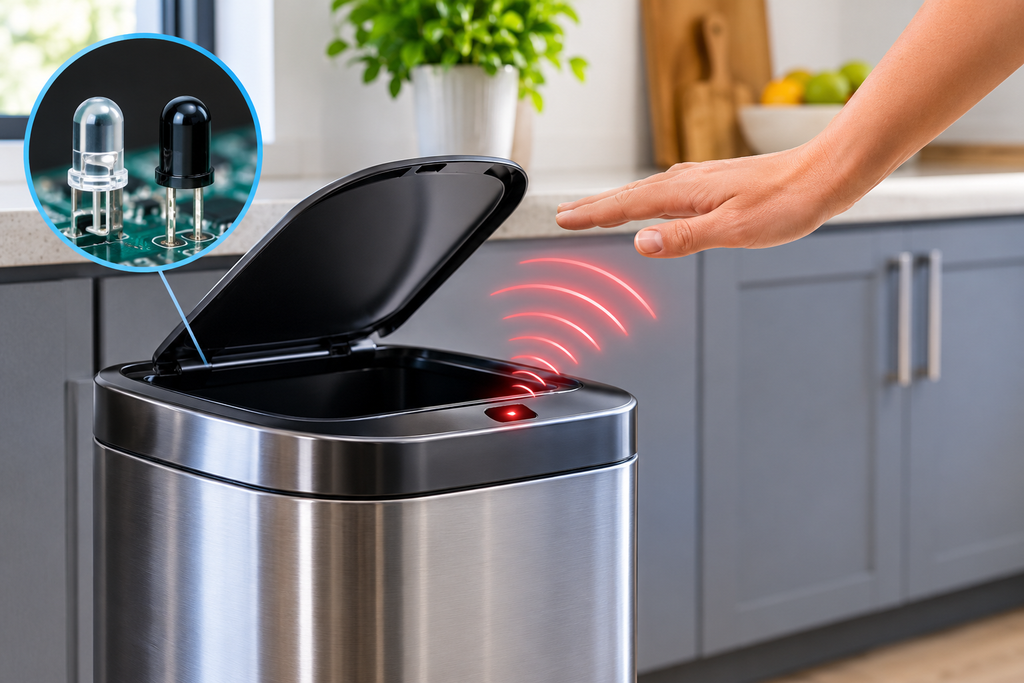
Imagine standing in your kitchen with messy hands, reaching toward a garbage can, and watching its lid open before you touch it. The technology behind that simple movement is more interesting than it looks. An infrared sensor trash can uses light-based detection to make hands-free waste disposal possible, and understanding the mechanism can help you choose and maintain the right model.
Quick Answer: An infrared sensor trash can uses infrared technology to detect an object near its lid. In common active infrared designs, an emitter sends invisible infrared light toward the detection area, and a receiver measures reflected light. When the signal reaches a programmed threshold, the control circuit activates a motor to open the lid.
Table of Contents
What You Need to Know
- Infrared sensors can detect nearby objects without requiring physical contact.
- Active infrared sensors commonly use an emitter and receiver to detect reflected infrared light.
- Passive infrared sensors detect changes in infrared radiation rather than emitting their own detection signal.
- Detection performance depends on sensor design, object characteristics, distance, and surrounding conditions.
- Cleaning the sensor area and maintaining the power supply can help prevent common operating problems.
How an Infrared Sensor Trash Can Detects Your Hand
An infrared sensor trash can detects nearby objects using infrared radiation and an electronic detection circuit. In a common reflective design, the sensor sends invisible infrared light toward the area in front of the lid and checks whether some of that light returns.
The process happens automatically, allowing you to approach the trash can without touching its lid.
The Infrared Emitter
An infrared emitter is an electronic component that produces infrared light. Infrared light is electromagnetic radiation that humans cannot normally see with their eyes.
In an active proximity sensor, the emitter directs infrared light toward a detection area. The light travels outward and may reflect from a nearby hand or another object.
The Infrared Receiver
An infrared receiver is a component that detects incoming infrared energy. Depending on the design, the receiver may use a photodiode or another light-sensitive detector.
When infrared light reflects from an object and returns toward the receiver, the receiver produces an electrical signal. The strength of that signal can provide information about the object’s proximity.
The Control Circuit and Lid Motor
The control circuit processes the sensor signal and determines whether the detection condition has been met.
If the signal passes the programmed threshold, the control board activates the motor mechanism. The motor moves the lid into its open position.
The sensor detects the object, but the control circuit and motor perform the actual lid-opening action.
Step-by-Step Working Mechanism of an Infrared Trash Can
A typical automatic infrared trash can follows a sequence involving detection, electronic processing, and motor activation. The exact sequence and timing depend on the manufacturer’s design.
Here is how a common reflective infrared system operates.
Step 1: Approach the Detection Area
Move your hand toward the sensor window above the trash can lid.
The sensor is positioned to monitor a specific area where users normally place their hands. Some models also provide a button or manual activation option.
Step 2: Infrared Light Is Emitted
The infrared emitter sends light toward the detection area.
The light is invisible to the human eye, so you generally cannot see the detection process happening.
Step 3: Reflected Light Reaches the Receiver
When your hand enters the detection area, some emitted infrared light may reflect toward the receiver.
The amount of reflected light depends on several factors, including distance, surface properties, sensor alignment, and emitter output.
Step 4: The Control Circuit Processes the Signal
The receiver converts the detected infrared energy into an electrical signal.
The electronic circuit evaluates the signal against its programmed detection threshold. If the required conditions are satisfied, the control system generates an activation command.
Step 5: The Motor Opens the Lid
The control board activates the motor, which moves the lid into its open position.
You can then dispose of waste without touching the lid.
Step 6: The Lid Closes Automatically
After the programmed opening period or when the system’s closing conditions are met, the motor closes the lid.
Some designs use additional sensing or control logic to prevent the lid from closing while an object remains in the detection area.
The surprising part: An infrared sensor does not necessarily recognize a hand as a hand. A basic proximity sensor responds to a qualifying infrared signal, which means other objects can sometimes activate the lid too.
Different Types of Infrared Sensors Used in Smart Trash Cans
Infrared sensing includes different technologies, and each works in a different way. Understanding these distinctions helps explain why two automatic trash cans can respond differently to nearby objects.
Active Infrared Sensors
Active infrared sensors generate their own infrared light and detect the reflected signal or interruption of an infrared beam.
A common reflective proximity arrangement includes:
- Infrared LED emitter.
- Photodiode or infrared receiver.
- Signal-processing circuit.
- Detection threshold.
Active infrared technology is suitable for detecting nearby objects without requiring direct physical contact.
Passive Infrared Sensors
Passive infrared sensors, commonly called PIR sensors, detect changes in infrared radiation from objects in their surroundings.
Human bodies naturally emit infrared radiation because of their temperature. A PIR sensor detects changes in the infrared energy reaching its sensing elements.
Unlike an active reflective sensor, a passive infrared sensor does not need to emit infrared light to perform its basic detection function.
PIR technology is commonly used in occupancy and motion-detection applications.
Reflective Infrared Proximity Sensors
A reflective infrared proximity sensor uses an emitter and receiver to detect infrared light reflected from nearby objects.
The amount of reflected energy can change as an object moves closer or farther away.
However, the sensor does not automatically provide an accurate absolute distance measurement. Some designs are intended only to detect presence or relative proximity.
According to Vishay’s technical documentation, reflected infrared signal strength depends on factors such as object reflectivity and sensor configuration.
For technical details, see the Vishay infrared proximity sensor application note.
How Does an Infrared Sensor Trash Can Compare With an Ultrasonic Sensor?
Infrared and ultrasonic sensors both support hands-free object detection, but they use different physical principles. Infrared systems detect light, while ultrasonic systems use high-frequency sound waves to determine whether an object is nearby.
The best choice depends on the application, sensor placement, and product design.
| Comparison feature | Infrared sensor | Ultrasonic sensor |
|---|---|---|
| Technology | Infrared light | High-frequency sound |
| Detection method | Reflected infrared energy or IR changes | Reflected sound waves |
| Main components | IR emitter and receiver in active designs | Ultrasonic transmitter and receiver |
| Light conditions | Ambient infrared light can affect some designs | Does not depend on visible light |
| Object characteristics | Reflectivity and surface properties can matter | Shape, angle, and sound absorption can matter |
| Detection environment | Optical interference can affect performance | Acoustic reflections can affect performance |
| Typical applications | Proximity detection and touchless controls | Distance measurement and object detection |
How Infrared Detection Works
An active infrared system sends infrared light toward an object and detects the reflected energy.
Its performance can be influenced by the reflectivity of the object and surrounding light conditions.
How Ultrasonic Detection Works
An ultrasonic sensor sends sound waves at frequencies above the normal range of human hearing.
The sound waves travel through the air, reflect from nearby objects, and return to the receiver.
The system can use the time taken for the sound to return to estimate distance.
Which Technology Is More Suitable for a Smart Trash Can?
Neither technology is automatically superior in every situation.
An infrared system may be suitable for a compact proximity-based lid activation system. An ultrasonic system may be useful when the manufacturer wants to detect objects using sound-based distance measurement.
When comparing products, examine the actual detection range, sensor placement, lid response, power requirements, and reliability information rather than choosing based only on the sensor name.
What Affects Infrared Sensor Detection?
Infrared detection depends on more than the presence of an object. The sensor’s optical design, surroundings, and the object’s surface characteristics can influence the signal received by the detector.
Object Distance and Sensor Position
The distance between your hand and the sensor can affect the amount of reflected infrared light reaching the receiver.
A hand positioned outside the designed detection area may not trigger the lid.
Sensor alignment also matters. If the emitter and receiver are poorly positioned, the system may receive an insufficient reflected signal.
Surface Reflectivity and Object Color
Different materials reflect infrared radiation differently.
A highly reflective object may return more infrared energy than a surface that absorbs or scatters much of the incoming light.
Visible color alone does not reliably predict infrared reflectivity. Two objects that look similar to your eyes may behave differently under infrared light.
Ambient Infrared Interference
Sunlight and other infrared sources can affect certain infrared receiver designs.
According to Vishay’s application documentation, ambient lighting and nearby reflective surfaces can influence the receiving range of infrared presence sensors.
This is one reason sensor performance should be evaluated under real operating conditions.
Sensor Dirt and Obstructions
Dust, grease, fingerprints, or other buildup around the sensor window can interfere with optical detection.
An object placed directly in front of the sensor may also block or disturb the detection area.
Keeping the sensor window clean and unobstructed helps maintain normal operation.
Common Infrared Sensor Trash Can Problems and Solutions
A touchless trash can that suddenly stops responding can be frustrating, especially when you are used to opening the lid without touching it. Fortunately, some common problems can be checked without opening the electronic components.
| Problem | Possible cause | What to check |
|---|---|---|
| Lid does not open | Weak or depleted batteries | Replace batteries according to the manual |
| Lid responds slowly | Obstructed or dirty sensor | Clean the sensor window |
| Lid opens unexpectedly | Reflections or unintended detection | Check the surrounding area |
| Lid does not close | Obstruction near the lid | Remove objects blocking movement |
| Sensor works inconsistently | Poor positioning or interference | Check placement and sensor area |
Why Does an Infrared Trash Can Not Open?
If the lid does not open when you approach, begin with the power supply and sensor area.
Try these checks in order:
- Check the batteries. Replace weak batteries with the type specified by the manufacturer.
- Inspect the sensor window. Look for dust, grease, or fingerprints.
- Remove nearby obstructions. Make sure objects are not blocking the sensor.
- Check sensor positioning. Approach the detection area from the direction recommended in the manual.
- Try the manual control. If your model includes a manual opening button, check whether the lid responds.
- Consult the manufacturer’s instructions. Follow the recommended reset or troubleshooting procedure for your model.
If the lid still does not work, the problem may involve the receiver, wiring, control board, or motor.
Avoid opening electronic components unless you have the appropriate technical knowledge. Contact the manufacturer or a qualified repair professional when necessary.
Why Does an Automatic Trash Can Open by Itself?
Unexpected opening can happen when the sensor detects an unintended signal.
Possible causes include:
- Moving objects near the detection zone.
- Strong reflections from nearby surfaces.
- Environmental infrared interference.
- Sensor contamination.
- An electronic fault.
Try repositioning the trash can and removing objects near its sensor window. If the problem continues, consult the product manufacturer.
Why Does the Sensor Respond Slowly?
A slow response can result from weak batteries, a dirty sensor window, poor sensor alignment, or a problem in the control system.
Start with simple maintenance before assuming the sensor is damaged.
Why Does the Lid Not Close Properly?
A lid may remain open because an object is blocking its movement or the detection system continues to register activity.
Check the lid’s movement path and remove any obstruction. If the motor makes unusual noises or the lid repeatedly stops, follow the manufacturer’s repair instructions.
How to Maintain an Infrared Trash Can Sensor
Regular maintenance helps keep the sensor area clear and supports reliable operation. Most basic cleaning tasks do not require technical equipment.
Follow these maintenance practices:
- Inspect the sensor window regularly. Look for dust, grease, and visible buildup.
- Use a soft cleaning cloth. Follow the manufacturer’s recommended cleaning method.
- Avoid excessive moisture. Do not spray cleaning liquid directly into the sensor or electronic housing.
- Check the battery compartment. Replace batteries when the product indicates low power or begins operating inconsistently.
- Keep the detection area clear. Avoid placing decorations or other objects directly in front of the sensor.
- Inspect the lid mechanism. Check for physical obstructions and follow the manufacturer’s cleaning instructions.
Never immerse the electronic lid assembly in water unless the manufacturer explicitly states that the component is designed for that use.
Email capture point: Want practical advice about touchless waste technology and smart-home products? Subscribe to the SmartTrashHub newsletter for helpful product research, maintenance tips, and buying advice.
Is an Infrared Sensor Trash Can Worth It?
An infrared-equipped automatic trash can can be a useful household convenience, especially when you want to open the lid without touching it.
However, the value depends on your daily needs, the quality of the sensor system, and the overall construction of the product.
Potential Benefits
- Hands-free lid activation.
- Less need to touch the garbage can lid.
- Convenient waste disposal while preparing food.
- Automatic operation.
- Modern design for kitchens and other household spaces.
Possible Limitations
- Battery replacement may be necessary.
- Sensor performance can vary between models.
- Unexpected activation may occur.
- Electronic components may require maintenance or repair.
- Some models have limited manual control options.
What Should You Look for Before Buying?
If you are considering an automatic touchless trash can, compare the sensor’s detection area, opening and closing mechanism, battery requirements, capacity, lid design, and warranty.
For your next step, compare an [infrared-sensor automatic touchless trash can]([AFFILIATE LINK: product]) with other automatic models based on these specifications. Choose a product that fits your available kitchen space and everyday waste-disposal needs rather than relying only on marketing claims.
Frequently Asked Questions About Infrared Trash Can Sensors
1. How Does an Infrared Sensor Trash Can Work?
An infrared sensor trash can detects nearby objects using infrared technology. In a common active reflective design, an infrared emitter sends invisible light toward the detection area. A receiver detects some of the reflected light, and an electronic circuit processes the signal. When the detection conditions are met, the control board activates the motor to open the lid automatically.
2. Does an Infrared Sensor Work in Darkness?
Yes. An active infrared proximity sensor can operate in darkness because it generates its own infrared light rather than depending on visible light. However, the actual performance depends on the sensor design, detection range, object characteristics, and environmental conditions. Some infrared systems can also be affected by external infrared sources, so performance varies between models.
3. Can Infrared Sensors Detect Objects Through Plastic?
Infrared detection through plastic depends on the plastic material, its thickness, and the infrared wavelength used by the sensor. Some plastics transmit certain infrared wavelengths, while others absorb or block them. A reflective proximity sensor generally detects the infrared signal returned from an object, so you should not assume it can reliably detect objects through every plastic surface.
4. What Is the Difference Between Active and Passive Infrared Sensors?
Active infrared sensors generate their own infrared light and detect reflected energy or interrupted beams. Passive infrared sensors detect changes in naturally occurring infrared radiation without transmitting their own detection light. Active reflective sensors are commonly associated with proximity detection, while passive infrared sensors are widely used for motion and occupancy detection.
5. Why Does My Infrared Trash Can Open by Itself?
An automatic trash can may open unexpectedly when its sensor detects an unintended signal. Nearby movement, reflective objects, ambient infrared interference, contamination around the sensor window, or an electronic fault may contribute. Move the trash can away from possible interference sources, clean the sensor area according to the manual, and contact the manufacturer if the issue continues.
6. How Do I Clean an Infrared Trash Can Sensor?
Turn off the trash can or disconnect its power if the manufacturer recommends doing so. Use a soft, clean cloth to remove dust and fingerprints from the sensor window. Avoid spraying liquid directly onto the sensor or allowing moisture to enter the electronic housing. Follow the manufacturer’s cleaning instructions before returning the trash can to normal operation.
7. Is Infrared Better Than Ultrasonic Technology?
Infrared and ultrasonic sensors have different advantages. Infrared sensors use light-based detection, while ultrasonic sensors use reflected high-frequency sound waves. Infrared performance can depend on optical reflectivity and ambient infrared conditions. Ultrasonic performance can depend on object shape, angle, and acoustic properties. The better choice depends on the product’s design and intended use.
8. What Can Interfere With Infrared Sensor Detection?
Ambient infrared light, nearby reflective surfaces, sensor contamination, object reflectivity, and sensor alignment can affect some infrared detection systems. The effect depends on the sensor’s optical design and signal-processing capabilities. If an automatic trash can responds inconsistently, check the sensor window and surrounding area before assuming the electronic system has failed.
What to Do Next
Understanding infrared detection is a useful first step, but smart trash cans include other technologies that can influence everyday convenience.
Continue learning with these SmartTrashHub resources:
- Explore Smart Trash Can With App to understand connected features and app-based controls.
- [CONTENT GAP: Best Automatic Touchless Trash Cans — future commercial buying guide.]
- [CONTENT GAP: How to Choose a Smart Kitchen Trash Can — future informational article.]
The right automatic trash can is not simply the one with the most technology. Look for a reliable detection system, practical capacity, convenient controls, and a design that suits your home.