
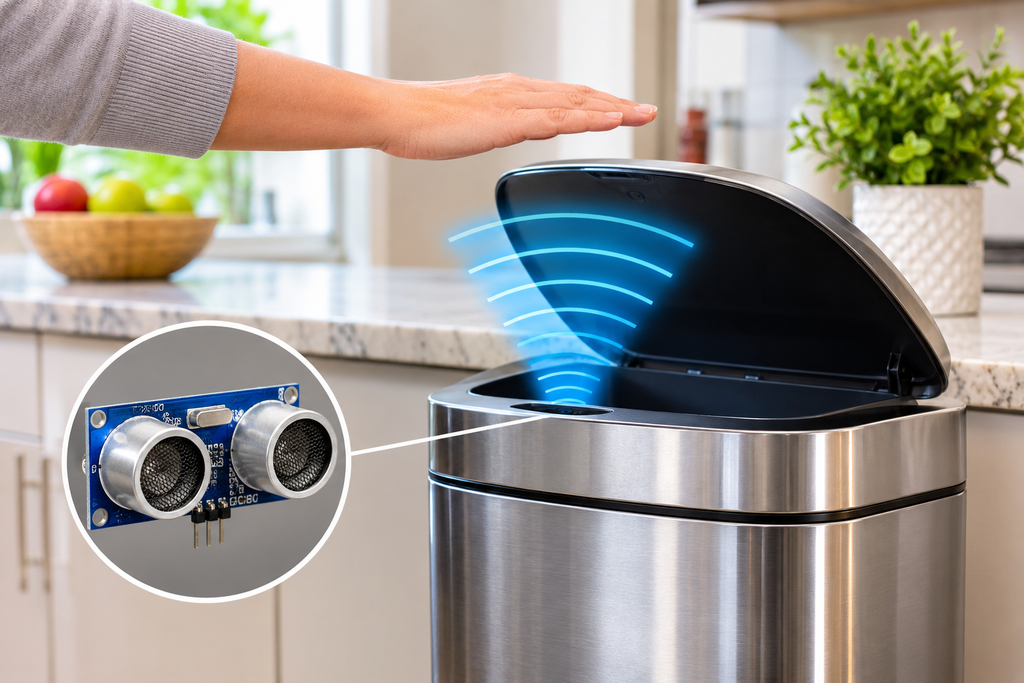
When your automatic trash can opens without anyone touching it, or refuses to open when you move your hand toward the lid, the sensor may be the first place to investigate. An ultrasonic sensor trash can uses sound-wave reflections to detect nearby objects, and understanding that process can help you identify false triggers, understand automatic lid operation, and explore DIY alternatives.
Quick Answer: An ultrasonic sensor trash can uses high-frequency sound waves to detect nearby objects. The sensor sends out an ultrasonic pulse and measures the time taken for its echo to return. A controller interprets the measured distance and activates a motor or actuator when the object meets the programmed detection conditions, opening the lid without physical contact.
Table of Contents
What You Need to Know
- Ultrasonic sensors detect objects by measuring reflected sound waves.
- A controller processes the sensor readings and controls the automatic lid mechanism.
- False triggers can result from reflections, unsuitable positioning, unstable readings, or control-system problems.
- Arduino boards can be used to build DIY automatic trash cans with ultrasonic sensors and servo motors.
- Ultrasonic proximity detection and waste-bin fill-level monitoring are two different applications.
What Is an Ultrasonic Sensor Trash Can?
An ultrasonic sensor trash can is an automatic waste container that uses sound-wave technology to detect nearby objects and activate its lid mechanism.
Unlike a traditional trash can, an automatic model can respond when a hand approaches its detection area. The user does not need to touch the lid to open it.
The system generally contains three main elements:
- Ultrasonic sensor: Detects nearby objects by measuring reflected sound waves.
- Control unit: Processes the sensor readings and determines when the lid should open.
- Motor or actuator: Moves the lid according to the controller’s instructions.
Some models also include a timer, battery indicator, manual controls, or additional sensors.
The exact configuration depends on the manufacturer and product design.
How does an Ultrasonic sensor trash can work?
An ultrasonic sensor trash can works by transmitting high-frequency sound waves, receiving their reflections, and calculating the distance to a nearby object. A controller checks the measured distance against its programmed conditions and activates the lid motor when those conditions are satisfied.
How Ultrasonic Waves Detect Nearby Objects
Ultrasonic waves are sound waves with frequencies above the normal human hearing range.
An ultrasonic distance sensor typically contains a transmitter and receiver. The transmitter sends a sound pulse, while the receiver detects the returning echo after the pulse reflects from an object.
The time between transmission and reception helps determine how far away the object is.
For example, when you move your hand toward an automatic trash can, the sensor can detect the change in distance and send information to the control system.
How Does the Sensor Measure Distance?
The sensor calculates distance using the travel time of the sound wave.
The basic formula is:
Distance = (Time × Speed of Sound) ÷ 2
The formula divides by two because the sound wave travels to the object and then returns to the sensor.
For example, if the measured round-trip travel time is 10 milliseconds and the assumed speed of sound is 343 metres per second:
Distance = (0.010 × 343) ÷ 2
Distance = 1.715 metres.
This is an illustrative calculation, not a recommended operating distance for a trash can. Actual detection depends on the sensor’s specifications, temperature, target surface, and installation.
How Does the Automatic Lid Open?
The sensor does not physically move the lid. A separate electronic control system operates the opening mechanism.
The process usually follows these steps:
- Detect an approaching object: The ultrasonic sensor sends out a sound pulse and receives its echo.
- Calculate the distance: The sensor or controller processes the echo travel time.
- Check the detection conditions: The control unit compares the reading with the programmed detection threshold.
- Activate the motor: If the conditions are satisfied, the controller sends a signal to the motor or actuator.
- Open the lid: The mechanism moves the lid into its open position.
- Close the lid: After the programmed delay or other closing conditions, the controller activates the closing mechanism.
The opening delay, detection distance, and closing behaviour vary between automatic trash can models.
What Are the Main Components of an Ultrasonic Trash Can?
An automatic ultrasonic trash can combines electronic components with a mechanical lid assembly. Each component has a separate responsibility.
| Component | Main function |
|---|---|
| Ultrasonic sensor | Detects nearby objects |
| Microcontroller | Processes detection readings |
| Motor or servo | Opens and closes the lid |
| Power source | Supplies electrical energy |
| Mechanical lid assembly | Transfers motor movement to the lid |
| Control circuit | Connects and manages electronic components |
A commercial automatic trash can may use a custom-designed control board rather than a separate Arduino-style development board.
The sensor, controller, and lid mechanism must work together for reliable automatic operation. A working sensor alone does not guarantee that the lid will open correctly.
Is an Ultrasonic Sensor Used for Lid Detection or Bin Fill-Level Monitoring?
Ultrasonic sensors can perform both functions, but the installation and purpose are different.
An automatic lid system detects a nearby hand or object. A fill-level monitoring system measures the distance between a sensor and the waste surface inside a container.
Lid Detection
For lid detection, the sensor usually faces the area where a person approaches the trash can.
When a hand enters the programmed detection zone, the controller can activate the opening mechanism.
The purpose is convenient, hands-free access.
Bin Fill-Level Monitoring
A fill-level sensor is generally mounted above the waste inside a container.
The sensor measures the distance between its position and the upper surface of the waste. As the waste level rises, the measured distance generally decreases.
According to the installation design, a monitoring system may use repeated readings to estimate how full the container is.
Commercial waste-monitoring systems can also transmit readings to a remote platform for collection planning.
For a technical example, see MaxBotix’s trash-level measurement information.
Why Are These Applications Different?
| Feature | Automatic lid detection | Bin fill-level monitoring |
|---|---|---|
| Main purpose | Detect approaching objects | Estimate waste level |
| Sensor position | Near the lid or approach area | Above the waste |
| Measurement target | Hand or nearby object | Waste surface |
| Main result | Open the lid | Estimate container fullness |
| Typical application | Household trash cans | Smart waste containers |
A sensor designed for automatic lid operation should not automatically be assumed suitable for commercial waste monitoring.
Why Does an Ultrasonic Sensor Trash Can Have False Triggers?
False triggering occurs when an automatic trash can opens even though the intended detection conditions have not been met. Reflected sound waves, sensor positioning, unstable readings, and control-system settings can contribute to this behaviour.
An unexpectedly opening lid can be frustrating, particularly when you are not standing near the trash can.
The cause is not always a defective sensor.
Can Nearby Objects Cause False Detection?
Yes. Nearby surfaces can reflect ultrasonic waves and influence the readings.
For example, a trash can positioned close to a wall, cabinet, or other object may experience unwanted reflections depending on the sensor’s orientation and detection pattern.
The control system may interpret an unexpected reading as an object approaching the detection area.
Can Moisture or Dirt Affect Sensor Performance?
Moisture, dirt, and residue around a sensor can affect its performance depending on the sensor’s construction and protection.
A contaminated sensor surface may interfere with the intended operation.
However, moisture does not automatically cause every ultrasonic sensor to malfunction. The actual effect depends on the sensor design and operating environment.
Can Incorrect Sensor Positioning Cause Repeated Opening?
Yes. Poor positioning can cause a sensor to detect objects outside the intended area.
For example, a sensor pointing toward a nearby surface may receive reflections that interfere with its normal detection behaviour.
Correct mounting and an appropriate detection area are important for dependable operation.
One Surprising Detail
An ultrasonic sensor can receive an echo from something other than the object you intended to detect.
That means a sensor may produce a distance reading even when the intended target is absent. This is one reason why sensor placement and control logic matter just as much as the sensor itself.
How to Troubleshoot an Ultrasonic Sensor Trash Can
Start by identifying exactly what the lid is doing. Different symptoms can point toward different sensor, power, mechanical, or control-system problems.
Use the following troubleshooting reference before assuming the sensor needs replacement.
Ultrasonic Sensor Trash Can Troubleshooting Chart
| Situation | Possible explanation | What to check |
|---|---|---|
| Lid opens when nobody is nearby | Unwanted reflections or detection conditions | Sensor positioning and detection area |
| Lid does not open | Object outside detection range | Sensor alignment and wiring |
| Lid opens repeatedly | Unstable distance readings | Sensor mounting and control logic |
| Lid remains open | Controller or actuator issue | Motor, power, and control conditions |
| Incorrect distance readings | Obstruction or unsuitable surface | Sensor position and measurement conditions |
| Bin fill reading is inconsistent | Uneven waste surface | Measurement location and averaging |
Save or screenshot this Ultrasonic Sensor Trash Can Troubleshooting Chart — it covers common symptoms, possible explanations, and practical inspection points.
The Lid Opens Without Anyone Nearby
Try these checks:
- Inspect the sensor area: Look for dirt, obstructions, or objects positioned directly in front of the sensor.
- Check sensor alignment: Confirm that the sensor is facing the intended detection area.
- Inspect the surrounding space: Nearby walls and cabinets may influence reflected readings.
- Check the control settings: If the manufacturer provides adjustable sensitivity or detection settings, review the instructions.
Do not open the electronic housing while the device is powered.
The Lid Does Not Open When an Object Approaches
Possible causes include a low battery, an obstructed sensor, a loose connection, or a damaged opening mechanism.
Check the manufacturer’s recommended battery and cleaning instructions first.
If the sensor appears to function but the lid does not move, the problem may involve the motor, actuator, or mechanical lid assembly.
The Lid Opens and Closes Repeatedly
Repeated movement can result from unstable sensor readings or control logic that reacts to small changes in measured distance.
For programmable DIY systems, filtering readings and requiring consistent detection over multiple measurements can help prevent unnecessary activation.
For commercial models, use only the sensitivity and operating adjustments permitted by the manufacturer.
The Sensor Gives Inconsistent Readings
Check whether the sensor is mounted securely and whether its detection area is obstructed.
In a DIY system, verify the wiring, power supply, measurement timing, and sensor specifications.
If the problem continues, consult the manufacturer’s support documentation or a qualified technician.
How to Build an Ultrasonic Sensor Trash Can DIY
You can build a basic automatic trash can using an ultrasonic distance sensor, an Arduino-compatible controller, and a servo motor.
The project requires electronics knowledge, appropriate power connections, and a suitable mechanical lid arrangement.
Components Needed for an Arduino Trash Can
| Component | Purpose |
|---|---|
| Arduino-compatible board | Controls the project |
| Ultrasonic distance sensor | Detects approaching objects |
| Servo motor | Moves the lid |
| Compatible power supply | Powers the electronics and motor |
| Jumper wires | Connects the components |
| Trash can with movable lid | Provides the physical structure |
A popular educational approach uses an HC-SR04 ultrasonic module, although other compatible modules are available.
Check the exact voltage, current requirements, and electrical compatibility of every component before connecting the system.
How to Connect an Ultrasonic Sensor to Arduino
Follow these general steps:
- Prepare the controller: Place the Arduino-compatible board on a stable, non-conductive surface.
- Position the sensor: Mount the ultrasonic sensor so it faces the intended hand-detection area.
- Connect the sensor: Connect the power, ground, trigger, and echo connections according to the sensor and controller documentation.
- Connect the servo: Wire the servo signal and power connections according to its specifications.
- Check the power supply: Ensure that the power source can support the controller and motor requirements.
- Inspect the wiring: Check for incorrect connections before supplying power.
The exact pin numbers depend on the selected board and sensor. Do not assume every Arduino-compatible board uses identical electrical connections.
How to Control a Servo Motor
A servo motor is an actuator that moves its output shaft to a commanded position.
For an automatic trash can, the servo can connect to the lid mechanism through an appropriate linkage.
Arduino’s official Servo library documentation explains how to control compatible servo motors.
The opening and closing positions must be adjusted to match the physical lid arrangement.
Basic Arduino Program Logic
The control program needs to perform several operations:
- Send an ultrasonic measurement pulse.
- Read the returning echo.
- Calculate the estimated distance.
- Compare the distance with the chosen detection threshold.
- Open the lid if the programmed conditions are satisfied.
- Keep the lid open for the selected delay.
- Close the lid when the closing conditions are satisfied.
A reliable program should also handle invalid readings and avoid activating the motor repeatedly from unstable measurements.
For programming concepts and supported functions, consult the official Arduino Language Reference.
DIY Prototype vs Commercial Automatic Trash Can
A DIY Arduino project is useful for learning how sensors and motors work together.
However, a commercial automatic trash can may have a custom controller, optimized mechanical components, protective housing, and power-management features.
A working prototype should not automatically be considered as reliable or durable as a finished household product.
Ultrasonic vs Infrared Sensors in Automatic Trash Cans
Ultrasonic and infrared sensors can both be used for touchless object detection, but they use different detection principles.
| Feature | Ultrasonic sensor | Infrared sensor |
|---|---|---|
| Detection principle | Reflected sound waves | Infrared light |
| Measurement method | Echo travel time | Reflected or interrupted infrared signal, depending on design |
| Environmental considerations | Acoustic reflections and sound conditions | Ambient light and target surface characteristics |
| Common application | Distance measurement | Proximity detection |
| Main limitation | Unwanted echoes and unsuitable targets | Detection can vary with surface reflectivity and sensor design |
Which Sensor Is Better?
There is no universal winner.
An ultrasonic sensor can be useful when distance measurement is required. An infrared sensor can be suitable for proximity detection in a compact design.
The right choice depends on the detection range, surroundings, target objects, power requirements, and product design.
The quality of the complete detection system matters more than simply choosing one sensor category over another.
What Should You Check Before Buying an Ultrasonic Sensor Trash Can?
Before choosing an automatic trash can, examine its detection behaviour, lid mechanism, power requirements, maintenance needs, and construction quality.
A sensor specification alone does not tell you how the complete product will perform in a real household.
Consider these factors:
- Detection behaviour: Check how the lid responds when a hand approaches.
- Opening mechanism: Look for a lid that moves smoothly without unnecessary noise.
- Power requirements: Review battery type, charging arrangements, and expected maintenance.
- Sensor positioning: Consider whether the sensor placement suits your kitchen or intended location.
- Build quality: Examine the lid, hinges, housing, and overall construction.
- Maintenance: Check how easy it is to clean the sensor area and replace batteries or components.
If you are comparing an ultrasonic distance sensor for a DIY project, a compatible ultrasonic distance sensor module is the essential equipment to investigate. Check its voltage, measurement range, interface, and manufacturer’s documentation before selecting one.
[AFFILIATE LINK: Compatible ultrasonic distance sensor module — add a verified Amazon product link if selected.]
Frequently Asked Questions
1. What is the price of an ultrasonic sensor trash can?
The price depends on the trash can’s capacity, construction, automatic lid mechanism, power system, and additional features. A basic automatic model and a premium smart waste container can belong to very different price categories. Compare current US retail listings and check the included features before deciding. No verified current price is available for a specific product in this article.
2. Can I make an ultrasonic sensor trash can using Arduino?
Yes. You can build an automatic trash can using an Arduino-compatible board, an ultrasonic distance sensor, and a servo motor. The sensor detects an approaching object, the controller processes the measurement, and the servo moves the lid. You must select electrically compatible components and design suitable mounting and power connections for the project.
3. Are ultrasonic sensor trash cans available for sale?
Yes. Automatic touchless trash cans are sold through online retailers and household product stores. Some models use ultrasonic sensing, while others use infrared or different detection technologies. Check the manufacturer’s specifications rather than assuming every automatic trash can uses an ultrasonic sensor. Also compare capacity, battery requirements, lid operation, warranty, and maintenance.
4. What is the best ultrasonic sensor trash can?
The best option depends on your household requirements, budget, available space, and preferred features. Look for dependable lid operation, suitable detection behaviour, durable construction, convenient power arrangements, and easy maintenance. Verify the actual sensing technology in the product specifications. There is no universally best model without comparing specific products and their verified performance.
5. What is a bin fill-level sensor?
A bin fill-level sensor measures the distance between a sensor mounted above the waste and the surface of the waste inside the container. An ultrasonic sensor can perform this task by measuring reflected sound waves. The system uses distance readings to estimate how full the container is. This application is different from detecting a hand to open a household trash can.
6. How does an automatic trash bin using Arduino work?
An Arduino-based automatic trash bin uses a distance sensor to detect an approaching object. The controller processes the sensor reading and sends a command to a servo motor when the detection conditions are met. The servo moves the lid, and the program controls when the lid should close. The exact wiring and program depend on the selected components.
7. Can an ultrasonic sensor detect objects through a trash can lid?
Not reliably through every lid material. Ultrasonic detection depends on how sound waves travel through the material, how the sensor is mounted, and how the reflected signal is received. A typical air-facing distance sensor should not be assumed capable of detecting objects through an ordinary solid lid. The actual sensor and installation must be evaluated.
8. Why does an automatic trash can open by itself?
An automatic trash can may open unexpectedly because of unwanted reflections, incorrect sensor positioning, unstable readings, or control-system problems. Nearby objects can influence the sensor’s detection area. Inspect the sensor surroundings, clean the sensing area according to manufacturer instructions, and check permitted sensitivity settings. If the problem continues, contact the manufacturer or a qualified technician.
What to Do Next
Understanding ultrasonic detection is a useful starting point, but the complete automatic lid system also matters.
Continue learning with these SmartTrashHub resources:
- Understand automatic lid systems: Read our Automatic Lid Trash Can guide to learn more about automatic opening mechanisms and touchless operation.
- Explore sensor technology: [CONTENT GAP: Ultrasonic vs Infrared Trash Can Sensors — future article.]
- Compare household products: [CONTENT GAP: Best Automatic Touchless Trash Cans for Home Use — future commercial comparison page.]
If you want practical updates, our SmartTrashHub newsletter can provide useful automatic trash can troubleshooting tips, sensor explanations, and smart waste technology information.
Final Thoughts
Ultrasonic sensors make touchless trash can operation possible by detecting objects through reflected sound waves. The sensor measures distance, the controller processes the reading, and a motor or actuator operates the lid.
Understanding the difference between proximity detection and fill-level monitoring also helps prevent confusion when researching smart waste technology.
For homeowners, the main priority is dependable operation and easy maintenance. For DIY enthusiasts, choosing compatible components and developing suitable control logic are essential steps toward building a functional automatic trash can.