

A kitchen garbage can can start smelling unpleasant even when the lid is closed, especially when food scraps and moisture remain inside. A suitable odor-control system can help reduce those smells, and understanding the different technologies will help you choose one that fits your home.
Quick Answer: A trash can with deodorizer uses an odor-control feature to reduce unpleasant smells inside the bin. Depending on its design, the system may use activated charcoal to adsorb certain odor compounds, fragrance inserts to mask smells, or another deodorizing technology. Its effectiveness depends on the filter, waste conditions, ventilation, and regular maintenance.
Table of Contents
What You Need to Know
- Activated charcoal filters capture certain odor compounds through a process called adsorption.
- Fragrance-based deodorizers mask unpleasant smells rather than necessarily removing their source.
- Plastic and stainless steel garbage cans can both support odor-control accessories or built-in systems.
- Filters have limited capacity and should be maintained or replaced according to manufacturer instructions.
- Cleaning the garbage can and managing wet food waste remain essential, even when a deodorizer is installed.
What Is a Trash Can with Deodorizer?
A deodorizer-equipped garbage can is a waste container that includes a feature designed to reduce unpleasant smells. The feature may be built into the lid, attached to the interior, or supplied as a separate accessory.
The main purpose of a deodorizer is to improve odor control, not to replace regular garbage-can cleaning.
Traditional garbage cans mainly hold waste. Odor-control models add another component to help manage the smells produced by food scraps, packaging, and other household rubbish.
Built-In vs. Separate Deodorizer Systems
There are two common ways to add deodorizing functionality to a garbage can.
| Feature | Built-in deodorizer | Separate deodorizer |
|---|---|---|
| Installation | Integrated into the trash can | Added by the user |
| Placement | Often inside the lid or filter compartment | Depends on the accessory |
| Compatibility | Designed for a particular model | Depends on the product |
| Replacement | May require a specific replacement filter | Varies by accessory |
| Convenience | Usually more integrated | Can be added to some existing bins |
A built-in system may provide a dedicated place for an odor filter. A separate deodorizer offers another option if your existing garbage can does not include odor-control technology.
Why Do Garbage Cans Develop Unpleasant Odors?
Household garbage can smell because organic waste breaks down and releases volatile compounds.
Common contributors include:
- Leftover meat and fish.
- Fruit and vegetable scraps.
- Food residue on packaging.
- Wet paper towels and tissues.
- Leaking food containers.
- Waste left inside the bin for extended periods.
Moisture and warm conditions can make odor problems more noticeable.
An odor filter may help manage some of the resulting smells, but removing waste and cleaning contaminated surfaces addresses the source more directly.
How Does a Trash Can with Deodorizer Work?
A deodorizing garbage can uses a material or mechanism to reduce unpleasant smells inside its container. Some systems adsorb odor compounds, while others release fragrance or use another odor-control approach.
The technology inside the deodorizer determines how the system manages unwanted smells.
A typical deodorizing system may work through the following process:
- Waste produces odor compounds. Food scraps, organic waste, and other rubbish release unpleasant-smelling substances.
- The odor reaches the deodorizing component. Air movement, openings, or the location of the filter allow some odor compounds to reach the deodorizer.
- The deodorizing material acts on the odor. Activated carbon can adsorb certain compounds, while fragrance products can mask unpleasant smells.
- The system continues working within its capacity. Filter condition, airflow, humidity, and waste conditions influence performance.
- Maintenance restores the system’s usefulness. Cleaning and replacing components when required help maintain odor control.
How Does Odor Adsorption Work?
Adsorption is a process in which molecules attach to the surface of another material.
Activated carbon contains a network of pores that creates a large internal surface area. Certain odor compounds can attach to those surfaces when they come into contact with the carbon.
Adsorption is different from absorption: adsorption occurs on a surface, while absorption involves a substance entering another material.
This difference explains why activated charcoal is commonly used in odor-control filters.
However, activated carbon does not capture every possible odor compound equally well. Its performance depends on the carbon properties, the chemicals present, humidity, and available adsorption capacity.
How Do Fragrance-Based Deodorizers Work?
Fragrance-based deodorizers release scented compounds into the surrounding air.
The fragrance changes the smell that reaches your nose, making unpleasant garbage odors less noticeable.
A fragrance insert may be useful when you want a more pleasant scent around a garbage can. However, masking an odor is not the same as removing the odor-producing material.
For example, a scented insert cannot remove leaking food residue from the bottom of a garbage can.
How Are Built-In Systems Different?
Built-in deodorizer systems are designed to work with a particular garbage-can structure.
Some models provide a compartment for a replaceable carbon filter. Others accommodate fragrance cartridges or different odor-control accessories.
Before purchasing a replacement, check the manufacturer’s documentation for:
- Compatible filter model.
- Correct installation position.
- Replacement instructions.
- Cleaning restrictions.
- Whether the deodorizer requires any additional components.
Not every automatic trash can includes an odor-control system. Automatic opening and deodorizing are separate features, even when both appear in one product.
What Types of Trash Can Deodorizers Are Available?
Different deodorizer products use different methods to manage garbage odors. The main options include activated charcoal filters, fragrance inserts, baking soda-based products, and stick-on accessories.
The best option depends on whether you want to capture odor compounds, mask unpleasant smells, or add an odor-control accessory to an existing bin.
Activated Charcoal Filters
Activated charcoal filters use porous carbon to capture certain odor compounds from air passing through or contacting the filter.
These filters are commonly placed inside a dedicated compartment, often near the lid of a garbage can.
Advantages:
- No added fragrance is necessary.
- Can adsorb certain gaseous compounds.
- Available in different filter formats.
- Some products offer replaceable filter cartridges.
Limitations:
- Adsorption capacity is finite.
- Humidity can affect performance.
- Not every odor compound is captured equally.
- Replacement filters may be model-specific.
Fragrance-Based Inserts
Fragrance inserts release scented substances that make the surrounding air smell more pleasant.
These accessories are available in different scents and formats.
They may suit households that prefer a scented garbage area, but fragrance should not be confused with actual removal of odor compounds.
Baking Soda-Based Deodorizers
Baking soda, also known as sodium bicarbonate, is used in some household odor-control products.
Its usefulness depends on the application, the amount used, and contact with the odor-producing material.
A baking soda-based product should not be assumed to perform like a dedicated activated carbon filter.
Stick-On Trash Can Deodorizers
Stick-on deodorizers attach to an appropriate surface inside a garbage can or lid.
They can be convenient for ordinary garbage cans that do not have a built-in deodorizer compartment.
Before using one, check the product instructions for surface compatibility, placement, and replacement requirements.
How Does an Activated Charcoal Filter Control Trash Can Odors?
An activated charcoal filter controls certain odors by allowing odor compounds to attach to the carbon’s porous surface.
Its effectiveness depends on the type and quantity of carbon, the compounds present, airflow, and environmental conditions.
The US Environmental Protection Agency explains that activated carbon is a commonly used adsorbent for gaseous pollutants, but different gases have different adsorption characteristics.
Its technical guidance also explains that adsorbent materials have limited capacity and require maintenance or regeneration. See the EPA Residential Air Cleaners Technical Summary.
What Activated Carbon Can and Cannot Do
Activated carbon can adsorb certain organic compounds, but it is not a universal odor remover.
For example, a carbon filter may help capture some compounds released by household waste. However, a filter’s performance against one compound does not prove that it can capture every smell from decomposing food.
The EPA’s Guide to Air Cleaners in the Home explains that gas filters are designed for particular pollutants and that their performance depends on the filter media.
One counterintuitive detail: A filter can look perfectly clean while its adsorption capacity is already becoming exhausted. Visual appearance alone cannot reliably tell you when a carbon filter needs replacement.
When Should You Replace a Carbon Filter?
There is no universal replacement interval for every garbage-can filter.
The correct schedule depends on the filter design, amount of carbon, waste conditions, and manufacturer’s instructions.
Check for these signs:
- The manufacturer’s recommended replacement date has arrived.
- Unpleasant odors are becoming noticeable again.
- The filter is damaged or contaminated.
- The replacement instructions identify a maintenance requirement.
Do not assume that every carbon filter lasts 30, 60, or 90 days. Those numbers should only be used when supported by the particular product’s documentation.
Why Does Filter Placement Matter?
Filter placement influences how much odor-containing air comes into contact with the deodorizing material.
A filter installed in a poorly ventilated compartment may receive less airflow than a system designed to move air through the filter.
When installing a replacement, follow the manufacturer’s positioning instructions instead of placing the filter wherever it fits.
Which Trash Can Material Is Better for Odor Control?
Plastic and stainless steel garbage cans can both be used with odor-control accessories. The material alone does not determine how effectively a garbage can controls odors.
Lid design, cleaning access, construction quality, and deodorizer compatibility are more useful comparison factors than material alone.
Plastic Trash Cans with Deodorizer Features

Plastic garbage cans are common household options.
Potential advantages include:
- Lightweight construction.
- Different sizes and shapes.
- Easy movement around the kitchen.
- Compatibility with certain stick-on accessories.
However, scratches and difficult-to-clean areas can retain food residue.
Choose a model with an interior that is easy to wash and a lid that fits properly.
Stainless Steel Trash Cans with Deodorizer Features
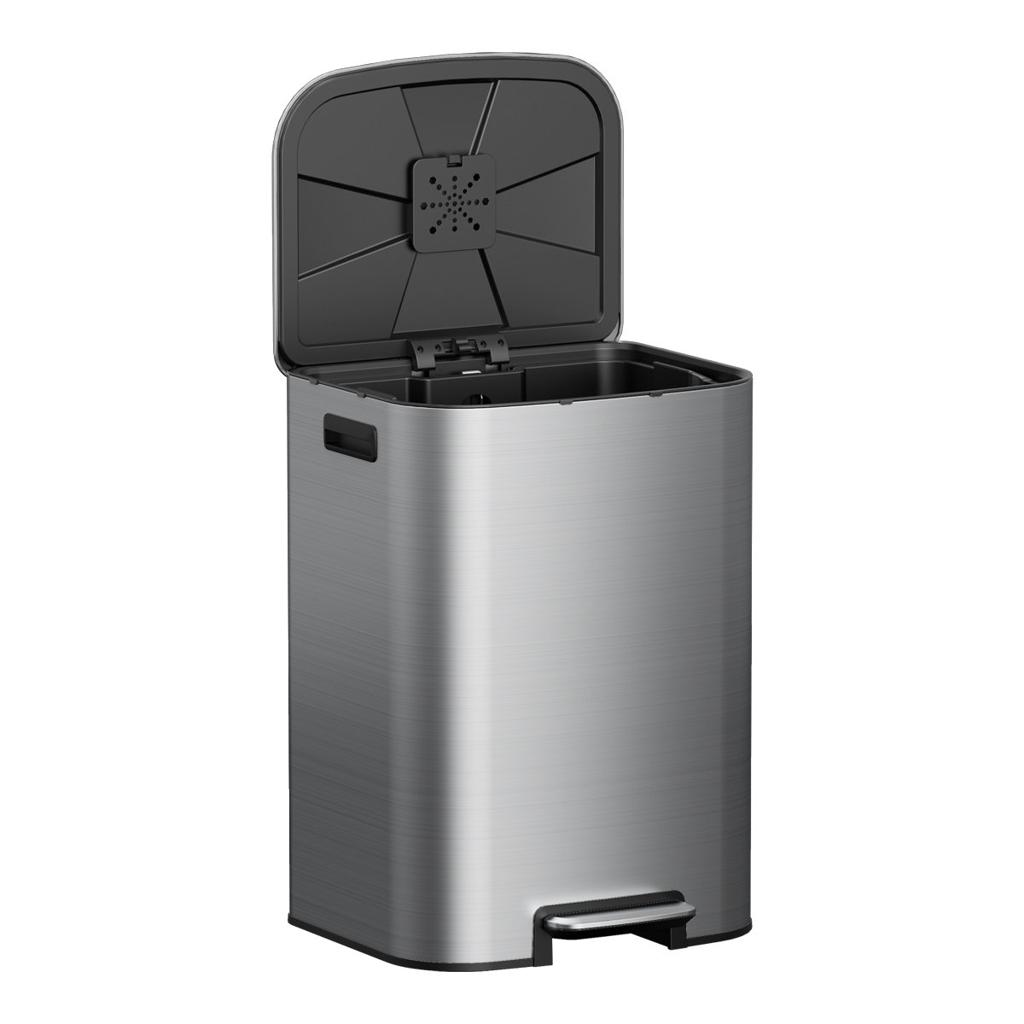
Stainless steel garbage cans are popular in modern kitchens because of their appearance and durable construction.
Potential advantages include:
- A clean, modern appearance.
- Easy wiping of many smooth exterior surfaces.
- Availability of integrated lid and filter designs.
- Compatibility with selected replacement accessories.
Stainless steel does not automatically prevent garbage odors. Food residue inside the container can still produce unpleasant smells.
Indoor vs. Outdoor Applications
| Application | Main concern | Useful consideration |
|---|---|---|
| Kitchen | Food scraps and moisture | Replaceable filter and easy cleaning |
| Bathroom | Personal-care waste and humidity | Suitable deodorizer placement |
| Outdoor | Heat, weather, and decomposing waste | Weather-resistant construction and secure lid |
| Garage | Mixed household waste | Adequate capacity and washable interior |
Outdoor garbage cans may face higher temperatures and changing weather conditions.
A deodorizer designed for an indoor kitchen bin should not automatically be considered suitable for outdoor use. Check the manufacturer’s stated operating conditions.
How Do You Maintain a Deodorizer and Its Trash Can?
Regular maintenance helps prevent odor buildup and keeps the deodorizing component in suitable condition.
Cleaning the container, removing wet waste, and replacing the filter when required are three important maintenance tasks.
Follow this practical process:
- Empty the garbage can. Remove the garbage bag and dispose of waste properly. Check the bottom for leaks or food residue.
- Inspect the interior. Look for sticky surfaces, liquid spills, and residue around the bottom and corners.
- Clean the container. Use a suitable household cleaning product according to the garbage-can manufacturer’s instructions.
- Dry the interior completely. Allow the bin to dry before installing a new bag. Moisture left behind can contribute to further odor problems.
- Inspect the deodorizer compartment. Check for dirt, damage, or a poorly positioned filter.
- Replace the filter when required. Use the correct replacement component and follow the manufacturer’s instructions.
- Install a fresh garbage bag. Make sure the bag fits correctly and does not block any designed airflow openings.
Never mix household cleaning chemicals, particularly bleach with ammonia or acidic cleaners. Follow product labels and use cleaning products only as directed.
How Can You Reduce Odors Between Cleanings?
Small household habits can make a noticeable difference.
- Drain excess liquid from food waste before disposal.
- Wrap particularly wet food scraps appropriately.
- Remove garbage regularly, especially during warm weather.
- Clean spills as soon as they happen.
- Avoid overfilling the garbage can.
- Keep the lid and surrounding surfaces clean.
A deodorizer works best as part of a broader waste-management routine, not as a substitute for hygiene.
Your Deodorizer Selection and Maintenance Reference Chart
Use this comparison when deciding which odor-control accessory is suitable for your garbage can.
| Deodorizer type | Main function | Maintenance consideration | Main limitation |
|---|---|---|---|
| Activated charcoal | Adsorbs certain odor compounds | Check condition and replacement instructions | Limited capacity |
| Fragrance insert | Masks unpleasant smells with scent | Replace as directed | Does not necessarily remove odor compounds |
| Baking soda-based product | Helps manage some odors | Refresh according to product instructions | Performance varies |
| Built-in deodorizer | Uses integrated odor-control technology | Follow model-specific instructions | Compatibility may be limited |
| Stick-on deodorizer | Provides localized odor-control or fragrance | Replace according to product instructions | Coverage depends on placement |
Save or screenshot this deodorizer selection and maintenance chart — it covers the differences between deodorizer types, their functions, and their maintenance requirements.
If you want a simple way to keep track of your garbage-can cleaning and filter replacement routine, the SmartTrashHub newsletter can provide practical smart-trash-can maintenance tips and useful household checklists.
Why Does a Trash Can Still Smell Even with a Deodorizer?
A garbage can can continue smelling even when its deodorizer is functioning because odor-control filters do not remove the waste producing the smell.
The most common problems are saturated filters, wet garbage, trapped food residue, and inadequate cleaning.
Saturated or Incorrectly Installed Filters
An activated carbon filter has limited adsorption capacity.
Once the available capacity is exhausted, the filter may become less effective. Incorrect installation can also reduce contact between odor-containing air and the filter.
Check the filter’s installation position and replacement instructions before assuming the entire garbage can needs replacing.
Wet Waste and Food Residue
Wet food scraps can produce strong smells as organic materials break down.
Liquid that collects beneath a garbage bag may remain unnoticed until you remove the bag.
Clean the affected surface, dry the interior, and avoid leaving leaking food containers inside the garbage can.
Dirty Lids, Seals, and Interior Surfaces
Odor-producing residue can accumulate around the lid, hinges, rim, and other hard-to-reach areas.
Clean these areas according to the manufacturer’s instructions.
If the odor continues after cleaning and filter replacement, inspect the garbage-can design for damaged seals, inaccessible compartments, or trapped residue.
Choosing Equipment for Better Odor Control
If your existing bin continues to develop odors despite proper cleaning and maintenance, comparing a smart trash can with a replaceable odor filter and a well-designed lid may help you find a more suitable solution.
The SmartTrashHub recommendation for your next research step is to compare models based on filter availability, cleaning access, lid construction, and replacement costs rather than choosing a product based on fragrance alone.
[CONTENT GAP: Create a commercial buying guide — Best Smart Trash Cans for Odor Control.]
Frequently Asked Questions About Trash Can Deodorizers
1. What should you look for in a plastic trash can with deodorizer?
Look for a plastic garbage can with a well-fitting lid, washable interior, and a compatible deodorizing compartment or accessory. Check whether the filter is replaceable and whether replacement components are easy to obtain. Plastic construction alone does not provide odor control, so the deodorizer design and cleaning accessibility matter more than appearance.
2. Is a stainless steel trash can with deodorizer better?
A stainless steel garbage can may offer a durable exterior and an attractive kitchen appearance, but stainless steel does not automatically eliminate odors. Look for a properly fitting lid, accessible interior surfaces, and a compatible odor filter. Both stainless steel and plastic models can provide useful odor-control features when properly designed and maintained.
3. How does a stick-on trash can deodorizer work?
A stick-on deodorizer attaches to a suitable surface inside or around a garbage can, depending on its instructions. Some versions release fragrance to mask unpleasant smells, while other products use odor-absorbing materials. Check the product label for placement, surface compatibility, and replacement instructions. A stick-on accessory cannot remove food residue or replace cleaning.
4. What is the best odor-blocking trash can?
The best odor-blocking garbage can depends on its lid design, construction, cleaning accessibility, and odor-control technology. Look for a model with a secure-fitting lid and a suitable replaceable filter if you prefer carbon filtration. No garbage can should be assumed to eliminate every odor, particularly when wet or decomposing waste remains inside.
5. Can you use a deodorizer in an outdoor trash can?
Yes, but you should choose a product specifically suitable for outdoor conditions. Outdoor garbage cans experience changing temperatures, moisture, and different waste conditions. Check the manufacturer’s weather-resistance and placement instructions. An indoor fragrance insert or small carbon filter may not provide suitable performance in an outdoor garbage container.
6. Is a kitchen trash can with deodorizer worth buying?
A kitchen garbage can with an integrated deodorizer may be useful if food scraps regularly create unpleasant smells. Activated carbon filters can help adsorb certain odor compounds, while fragrance-based systems can make the surrounding air smell more pleasant. The value depends on replacement costs, cleaning requirements, and how effectively the system suits your household’s waste.
7. Is an Arm & Hammer trash can deodorizer the same as an activated charcoal filter?
Not necessarily. Different deodorizer products use different ingredients and odor-control methods. A branded deodorizer should not automatically be classified as an activated charcoal filter unless its product documentation confirms that material. Check the manufacturer’s ingredient list and product description to understand whether the product absorbs odors, neutralizes particular compounds, or masks smells with fragrance.
8. How often should you replace a trash can odor filter?
Replace a garbage-can odor filter according to its manufacturer’s instructions. There is no universal replacement schedule because filters differ in material, size, capacity, and operating conditions. Noticeable odor returning can be a reason to inspect the filter, but appearance and smell alone cannot establish its remaining capacity. Use the recommended replacement component for your specific model.
What to Do Next
Controlling garbage odors requires more than adding fragrance. Choosing an appropriate filter, maintaining the garbage can, and removing odor-producing waste are all part of an effective routine.
If you want to learn more, continue with these SmartTrashHub resources:
- Smart Trash Can Odor Control — Explore practical ways to manage unpleasant smells in a smart garbage can.
- [CONTENT GAP: How to Replace a Smart Trash Can Odor Filter] — Learn about filter replacement and maintenance.
- [CONTENT GAP: Best Smart Trash Cans for Odor Control] — Compare future product recommendations and odor-control features.
A clean garbage can, an appropriate deodorizer, and regular maintenance can make your kitchen waste routine more manageable.